


I raised my kids in New York City and I sent them to a school I won’t name here.
I actually loved it at first. The approach was closer to Montessori than anything traditional. Kids learned at their own pace, called their teachers by their first names, sat in clusters instead of rows, and spent a lot of time on the floor doing the whole criss-cross applesauce thing. It felt progressive. It felt intentional.
But there was one thing I couldn’t stand.
They let the kids sound out words and then debate whether that was how the word was actually supposed to be spelled. Instead of telling a child that C-A-T is cat and not K-A-T, they turned it into a discussion. A discovery. An exploration.
For Years — and I mean years — my kids had poor spelling. Junior high. High school. They were never the kids who loved reading either. Part of that was the other half of their DNA, and I’ll leave that alone. But I’ll say this: they were never encouraged to read at home when they weren’t with me, even though I tried to model that behavior every chance I got.
Looking back, maybe the spelling thing was foreshadowed. Because I had my own issues with spelling in elementary school.
The difference is — I fixed it. Quickly.
One of my teacher’s name was Mr. Dougan. He called me up to the chalkboard in front of the whole class and told me to spell the word “business” out loud. I froze. I had no idea. Probably spelled it “bizness” or something close. Just sounding it out, getting it wrong every time.
He didn’t let me off the hook.
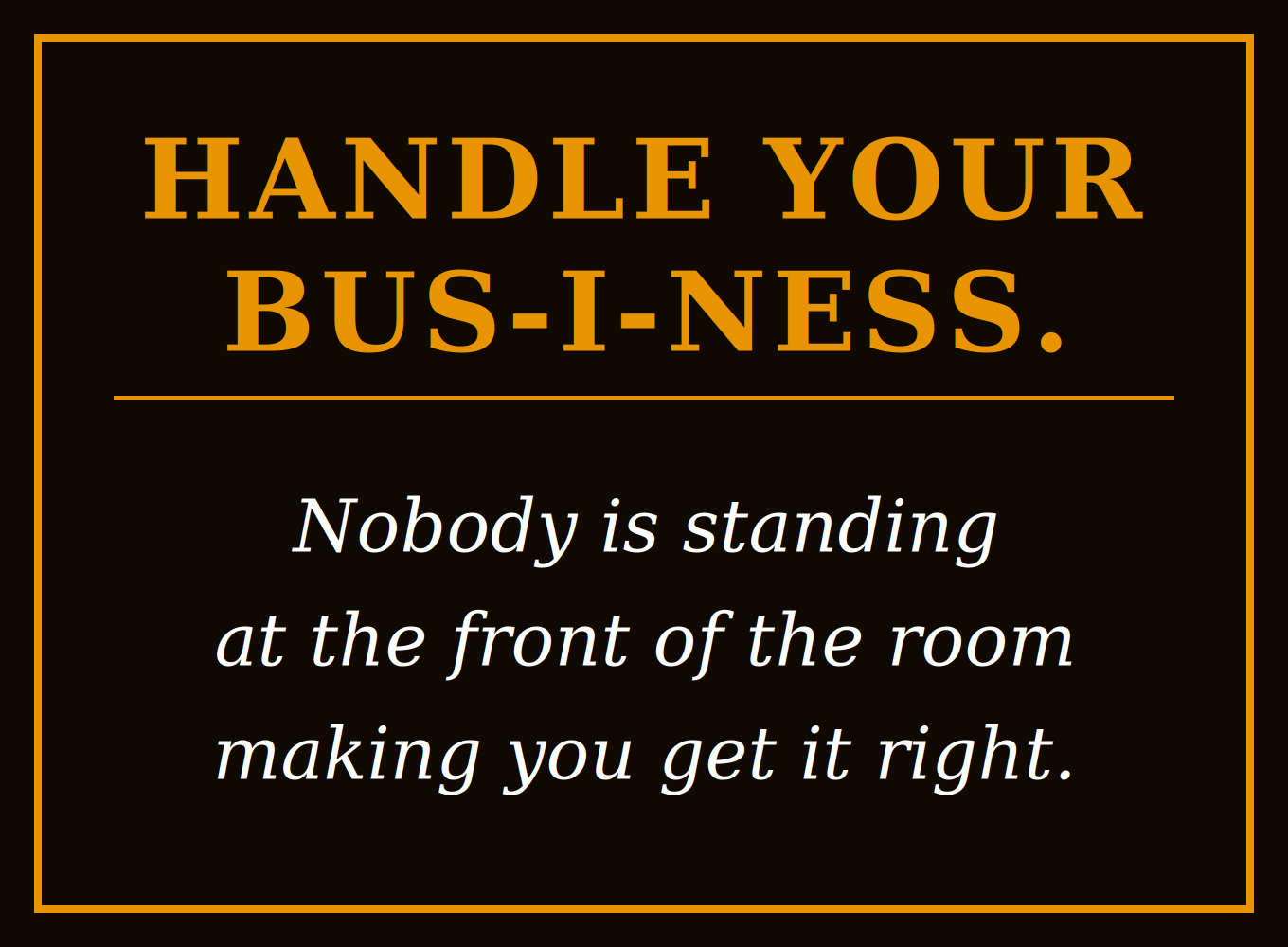
He made me try again. And again. Twenty-five different attempts before I finally got it right. Bus. I. Ness. Three syllables. From that day forward, I never forgot how to spell it, and somewhere in the back of my mind, I never forgot what it meant to actually handle yours.
Mr. Dougan didn’t debate with me. He didn’t turn it into a discovery. He stood at that chalkboard and made me get it right, however long it took, however uncomfortable it got. That’s not cruelty. That’s accountability. And it stuck in a way that a classroom discussion never would have.
Now think about what I see happening with musicians every single day. They’re sounding out the business side of their careers and calling it figuring it out. They’re debating whether the word is spelled correctly instead of just learning to spell it. There’s no Mr. Dougan. No chalkboard. No twenty-five attempts. Just vibes and hope and wondering why the money never adds up.
Here’s the part most people don’t know about me.
I didn’t go to Berklee, or any other music school. That’s what I wanted. My father had other ideas, and I ended up at Howard University’s School of Business. I hated it. The students around me were cold and aggressive in a way that didn’t sit right with me at all. I spent most of my time in the music building with the Fine Arts kids, playing gigs, leading the drumline. Those were my people.
But the business school planted seeds I didn’t even know were growing.
After Howard, I didn’t go straight into music. I stayed in DC for a while, managing record stores and picking up gigs wherever I could. When I finally made the move to New York, I did what a lot of musicians do. Day job to survive, gigs at night to stay alive. I was determined to get where I am now. But it was that business degree that kept me afloat while I was figuring it out. It gave me options when the gigs weren’t enough.

I spent my first five years in New York City with a day job. Donaldson, Lufkin & Jenrette, handling international reconciliation, tracking foreign currency and money moving across borders. Years later, I moved to MetLife as a financial services representative, got my Series 6 and Series 63 licenses, and spent a few years sitting across from real people talking about their money. Retirement plans. Annuities. Life insurance. People who were counting on me to help them figure out what their future was supposed to look like. Then came Chase, where I worked as a personal banker, meeting with clients, opening accounts, and helping people think through their financial goals.
Kids today call them survival jobs. I get that. But here’s what I know now that I didn’t know then — every job you have, every experience you accumulate, shapes you in ways you don’t fully understand until years later. Those jobs weren’t detours. They were deposits. And when I finally made the jump to full-time musician, I could negotiate. I could walk away from bad gigs. I understood where the money went and why. None of it felt glamorous at the time. But all of it paid off.
Nobody in that pit is going to hand you a financial plan. Nobody’s going to tell you to track every source of income, sort your expenses into what’s fixed and what’s variable, and build an emergency fund so that when the show closes you’re not desperate. Nobody’s going to explain what Local 802 is actually there to do, which is fight for your minimum wages, your overtime, your rehearsal pay, your pension credits. And none of it is automatic. You have to know what you’re entitled to. You have to read the contracts. You have to ask the questions. Because confusion is not an excuse they’ll accept when you leave money on the table. Nobody’s going to sit you down and walk you through the difference between a Traditional IRA, a Roth, and a Solo 401(k) and why any of it matters when you’re a freelancer with no employer doing it for you.
You pick it up yourself, or you don’t pick it up at all.
There’s a whole chapter on this in Broadway Bound and Beyond — the financial side of a Broadway career that nobody teaches you in school, in the pit, or on the bandstand.
Mr. Dougan didn’t let me off the hook until I got it right. This chapter is me returning the favor.
Handle your bus-i-ness.
Once again it amazes me, how utterly opposite your background and life story are from my own. How on earth did the likes of you ever find common ground with the likes of me?
By age five when I entered first grade I already knew how to read because I had made everyone in my family tell me what words on road signs and cereal boxes said, what they meant, why on earth this spelling thing made so little sense (they had no clue). I had not been in school more than a few weeks before my first teacher had put me in service tutoring the other kids on reading and comprehension, which of course did me no end of harm on the playground and the school bus....
And this was the irony which shaped my life more than any amount of 'proper learnin' ever did: you see, when one grows up among the lowest-ranking sector of an emergent white-suburban (southern) middle class, and all anyone's roots around oneself spelled was 'white trash', to learn things properly and to examine meanings of things was trained in as 'puttin' on airs', as exceeding one's heaven-assigned place in life.
Because one is, after all, not one of the 'coloreds', which means that one's position of rank in the hierarchy of things had already been established, and one ought to thank God one had been born white; and above all, one must never become like one of them libburls, folks from up north who think they know things because they'd read some books, when everyone knows them univers-tees is turnin' out a pack of communist agitators, etc, etc.
Seriously. I'm probably making it sound more sane than it actually was. You were never exactly wrong about the south, the south just changed, a lot, since way back then. When I was growing up, the south was why Oscar Peterson and them were moving to Copenhagen and Paris, so they could play a gig and talk to pretty girls afterward without being strung up for it.
There was a cold war on around the world, and there had not stopped being a race war on across the USA, since many generations before.
One went to church and sang 'count your blessings, name them one by one', and then one went to all-white schools (post-Civil Rights Act: southern schools were in no hurry to accommodate this Thurgood Marshall and this Doctor King, who of course were also Red agitators), and learned to watch one's ass by never, ever allowing anyone to think one thinks oneself to be smart, or headed anywhere worth striving for if this was not fittin' for properly brought-up white trash, or interested in anything which would stamp oneself as too Red. Doing what one was told was regarded as the highest achievement worth aiming for, and if this made one some money, well, count your blessings son, and don't let it go to your head. And never, EVER, make anyone think you are fighting for your rights, like them Reds do.
And this was only the beginning of my own odyssey of learning. It got even more confusing than this, believe me. But by the time I didn't finish high school, because I'd done all the work of educating myself all along and wasn't about to give any institution the credit for it, my concept of ambition had been shaped mostly by having learned to want nothing to do with this adulthood thing, because it too had so failed to impress me, in any way, as a thing worth striving for.
Nobody had ever articulated to me what it was I could ever do with being 'smart', nobody had ever shown me any path toward 'success' of any kind, nobody had ever demonstrated to me that this filthy business (see, I spelled it right the first time) of making money was anything but a sleazy hustle at others' expense. So I set my mind to drop out of society, and make my own way, doing life my own way, as best I could manage.
I guess I've managed all right. But one could hardly call how, good management.
Never did learn that one.