


Last night was one of those nights I’m going to remember for a long time. And I want to tell you about it the right way, because there’s a real lesson buried inside what happened — one that applies to anybody trying to build a career in this industry. But I’m going to give you the results first.
Cats: The Jellicle Ball won three Tony Awards last night. Best Direction of a Musical for Zhailon Levingston and Bill Rauch. Best Choreography for Omari Wiles and Arturo Lyons. And Best Costume Design of a Musical for Qween Jean.
We didn’t win Best Revival of a Musical. That went to Ragtime. I have nothing bad to say about that. From everything I’ve heard, that show is a masterpiece, and the people involved worked hard and deserved everything they took home.
Schmigadoon! won Best Musical, and I want to say something about that because I think people underestimate how much that award matters compared to Best Revival. A revival already has a proven title, a built-in audience, and a cultural footprint working in its favor before the curtain even goes up. A new musical has none of that. It lives or dies entirely on what it builds from scratch, and when you win Best Musical it can completely change the trajectory of a show’s run.
I know this because I lived it.
In 2010 I was the drummer for Memphis: The Musical. Nobody was writing think pieces about how Memphis was going to change Broadway. We just kept doing the work, and then we won Best Musical, and something shifted almost immediately. We wound up running 1,166 performances and closed in August of 2012. I hope Schmigadoon! and The Lost Boys get that kind of staying power, because my colleagues are in those pits eight shows a week and they deserve a long run.
Now here’s where the night gets interesting. And this part connects directly to something that happens inside our show every single night.
Every performance of Cats: The Jellicle Ball features two celebrity guest judges for the ballroom competition at the center of the show. The audience doesn't know who's coming until they're announced, and when it's somebody the crowd loves, the reaction is really fun to witness.
Over the course of this run I've had some remarkable backstage moments because of it. Shonda Rhimes. Laurence Fishburne. Quinta Brunson and Tyler James Williams from Abbott Elementary. And I'll be honest, when it's an actor or a TV personality, I tend to clam up. I don't have a great natural entry point beyond being a fan, and "I love your work" is the most boring thing you can say to somebody who hears it fifty times a night. So I shake hands, take the photo, say something forgettable (or regrettable), and walk away feeling like I left something on the table.


But when it's a musician, something different happens. All of a sudden I have a commonality that goes deeper than admiration. We speak the same language. And for me, that changes everything about how the conversation starts.
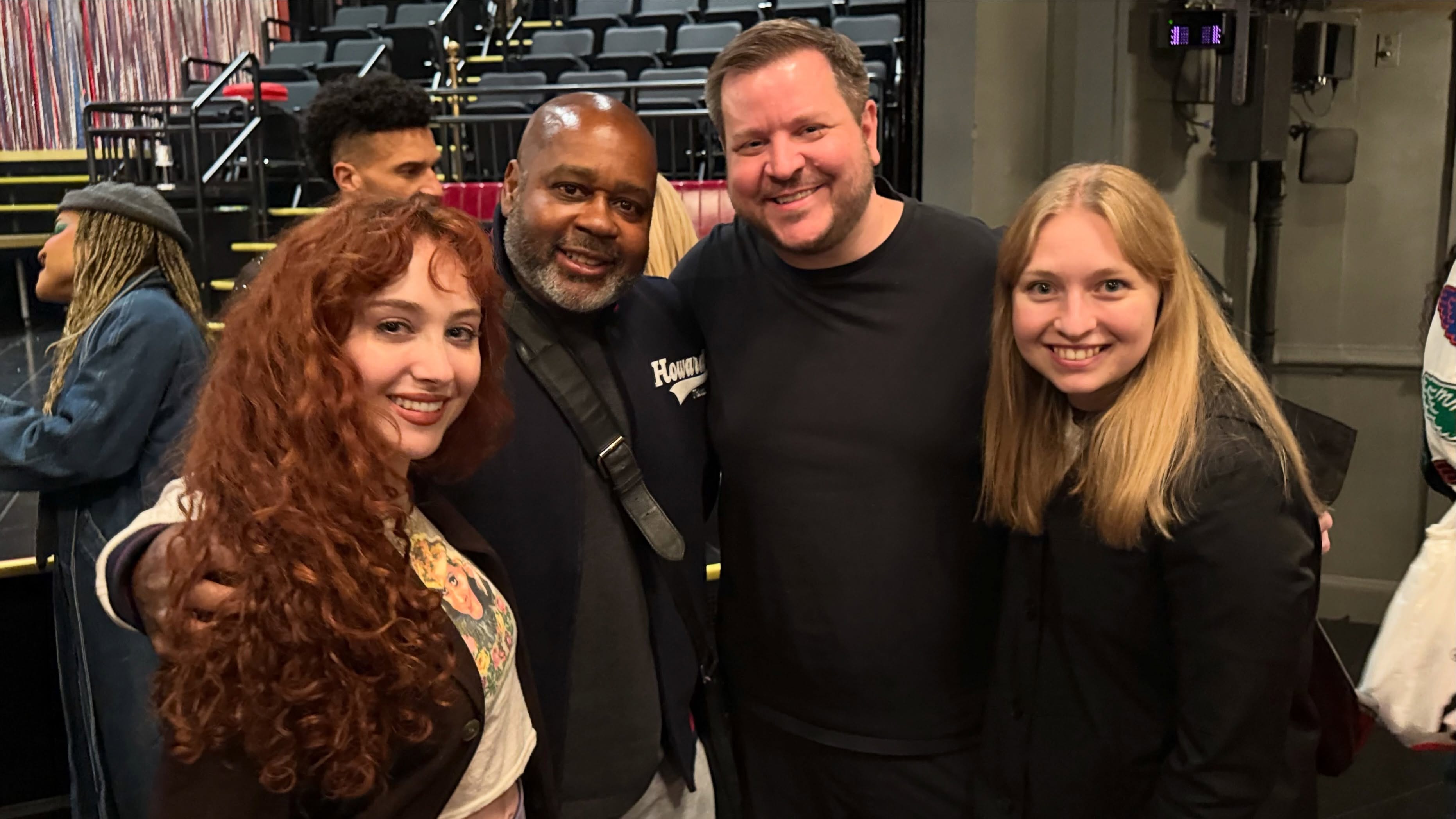
When Chappell Roan came through, I already had my opening before I even got to her. I know her drummer, Lucy Ritter. I met Lucy years ago when she was on the road with Jagged Little Pill, and by the time she landed with Chappell she had completely transformed. Full rock star, drumming for one of the biggest pop acts on the planet. When Chappell introduced herself to me she said “Hi, I’m Kayleigh,” which gave me a genuine half-second of confusion before I realized that’s her goverment name. I told her I knew Lucy and she lit up immediately. We talked about touring, talked about the road, took the photo, and kept it moving. The whole conversation had a different energy than the ones I fumble through with people I’m just a fan of. I had something real to say, and it opened a door that “I love your work” never would have.
That's the thing I keep coming back to. The door. And whether or not you walk through it when it opens.
Which brings me to last night.


At the after party I found myself standing near Andrew Lloyd Webber. The man is a living legend. Over 20 musicals. Cats. Phantom of the Opera. Evita. Jesus Christ Superstar. A career that has literally shaped what Broadway looks and sounds like for the last fifty years. And yet standing there talking to him I wasn’t star struck the way I get around television personalities. I think it’s because music is the language I actually speak, and I’ve been playing his charts long enough that the conversation felt less like meeting a celebrity and more like finally getting to ask questions I’d been thinking about for years.
What I really wanted to ask him was about his time signatures. If you’ve ever played an Andrew Lloyd Webber score you know exactly what I’m talking about. The man will have you in 13/8, then shift to 6/8, then 9/8, then right back, sometimes all within the same song. I have spent significant portions of my professional life just counting my way through his music, and I really wanted to look him in the eye and ask why he couldn’t just stay in 4/4 and let the rest of us live.
But I kept that one in my pocket. The man is a multibillionaire whose musicals have played every major city on earth. I’m a drummer who wrote a book about breaking into Broadway, hosts a podcast about the industry, and has an online course dropping soon. Not quite the same résumé, but the book is doing well in its category on Amazon, so I’ve got that going for me. A Tony Awards after party is probably not the ideal setting to interrogate a legend about odd meters. I’ll save that for next time.
So instead I asked him the softball question. Out of all of his musicals, 20-something deep, which one is his favorite?
He said he didn’t have one.
Which is honestly the only answer a person in his position can give, and probably the most truthful one too. It’s the same thing almost every parent says when someone asks which kid they love most. You might have an answer. You’re probably never going to say it out loud. But what struck me wasn’t that he dodged the question. It was the way he said it, like someone who genuinely doesn’t think about his catalog that way. He’s not sitting around ranking Phantom against Evita. He made them, moved forward, and made the next one.

Here’s what all of it comes back to. The access. The conversations. The moments where you’re standing at a Tony Awards after party talking to Andrew Lloyd Webber. Nobody handed me any of that. It didn’t happen because I was the best drummer in my hometown, my college, or even in New York City. There are hundreds, maybe thousands of players just as talented, and most of them are better than me on the kit. What separates the people who build lasting careers from the ones who don’t isn’t ability. It’s showing up long enough and consistently enough that when the door opens, you’re standing right there, and you actually have something real to say when it does.
I kept my best question in my pocket last night. But I introduced myself, I had the conversation, and I didn’t waste the moment.
But look, the next time I see Sir Andrew, we’re talking about the 13/8 stuff!
Speaking of people who didn’t waste their moment — my next podcast guest is Jared Shaw, a drummer who graduated from NYU Steinhardt. He showed up to a Tina Turner Broadway rehearsal as a college student just to observe. The regular drummer didn’t show up on time. Contractor John Miller scanned the room and put Jared on the kit. He sight-read 15 minutes of a mega-mix he had never seen before, styles flipping every 16 bars, a section in 3/4 buried in the middle, and that one unplanned moment eventually led to his first touring gig with Beautiful. Not because he was perfect that day, but because he had been preparing long before that day ever came.
That conversation drops soon. Stay tuned.
Get the book at broadwayboundbook.com
13/8 RULES!
I was just rehearsing a “Phantom” medley with the South Jersey Pops. I turned to the timpanist and said, “Genius by the Great Man”! He countered by saying, “I hate Andrew Lloyd Webber.” I countered by saying I’ve never been emotionally moved by Mozart. Any Mozart. Ever. Meeting Sir Andrew? Wow! By the way ... love your work, Clayton.